

tsfields
L1
Hi all,
I am working on/for a grazing ecology research project this summer, on a bison ranch. I decided to do a little personal collecting in the field today, and I had some things happen that I'd like some expert input on, as I'm pretty new to insect collecting. I worked on this project last summer, and part of my job was trapping and identifying dung beetles, which got me very excited about insects—dung beetles especially.
Anyway, I collected quite a few Aphodius spp., among other things, from bison dung pats today, and stored them in alcohol, in a whirl-pak, in the glove-box of the side-by-side I was driving during the afternoon in the field. This is the only way I could really store them, at least with the "equipment" I have at the moment. Later in the day, I was examining my specimens in their bag, and I noticed that a number of them seemed to be stretched or bloated between the head and thorax, and the thorax and abdomen. Also in the general area of the genital opening. I'm sure there's a term for this, but I don't know it. In one case, it was prolapsed, but I didn't take a picture of that.
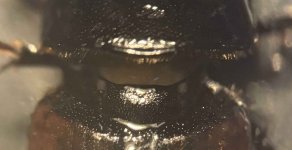
See connection between thorax and abdomen of Aphodius fimetarius (I think, not certain):
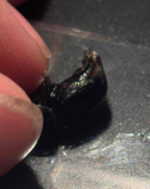
And the genital area of an as-yet-unknown dung beetle (please forgive the low-quality; I had to compress and trim to all heck to make it small enough to upload):
The two questions I have are: will this return to normal/shrink back up as the beetles dry? And: is there a way to prevent this when in the field for a long time?
Thanks everyone.
I am working on/for a grazing ecology research project this summer, on a bison ranch. I decided to do a little personal collecting in the field today, and I had some things happen that I'd like some expert input on, as I'm pretty new to insect collecting. I worked on this project last summer, and part of my job was trapping and identifying dung beetles, which got me very excited about insects—dung beetles especially.
Anyway, I collected quite a few Aphodius spp., among other things, from bison dung pats today, and stored them in alcohol, in a whirl-pak, in the glove-box of the side-by-side I was driving during the afternoon in the field. This is the only way I could really store them, at least with the "equipment" I have at the moment. Later in the day, I was examining my specimens in their bag, and I noticed that a number of them seemed to be stretched or bloated between the head and thorax, and the thorax and abdomen. Also in the general area of the genital opening. I'm sure there's a term for this, but I don't know it. In one case, it was prolapsed, but I didn't take a picture of that.
See connection between thorax and abdomen of Aphodius fimetarius (I think, not certain):
And the genital area of an as-yet-unknown dung beetle (please forgive the low-quality; I had to compress and trim to all heck to make it small enough to upload):
The two questions I have are: will this return to normal/shrink back up as the beetles dry? And: is there a way to prevent this when in the field for a long time?
Thanks everyone.


