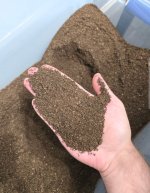
Flake soil outside all year long...

Last summer I made two batches of twice fermented flake soil using this process:
Starting with 20 lbs of oak pellets, I added water and 5 lbs of whole wheat flour and fermented outside in my composter turning/mixing each day for 4 weeks. Then I added another 5 lbs of whole wheat flour and followed the same process for another 4 weeks. This process created 1 batch of flake soil suitable for raising my rhino beetles through pupation. I created two batches following this process and attempted to start a third at the end of the summer, but by week 3-4 of the third batch it started getting colder at night in August here in northern USA so I wasn't able to really get it heated up like it needed. So basically I got lazy and always intended to remove it and maybe use it for stag beetles but it stayed out there all year long, through the fall, winter and spring until now (mid-June).

Now to my question... Based on how it looks to you, is it possibly even better for rhino beetle larvae than my regular twice-fermented process? Or is it possibly too "digested"? It is very dark but it passes the smell test, no funkyness other than a slight hint of feet like I am used to with flake soil. At the very least I can keep it for breeder boxes rather than for raising larvae. Just curious to get y'alls thoughts. Thanks in advance!
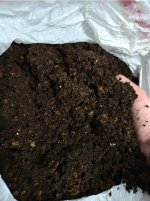
1000036303.jpg
 
For what its worth, my research suggests this is perhaps almost "black soil" and probably excellent for Dynastes. Thanks for all the replies lol. Still interested in any thoughts though.
 
I think it may be too digested if it's been out that long.
I don't know if you've ever seen Daniel Ambuehl on YouTube, but this swiss gentlemen I believe makes his in a woven sack in the garden in contact with these soil all year. Mine was sitting in a tumbler. I feel like its gotta still be good for Dynastids at least.
 
The substrate in the picture seems rather deteriorated. Smell and see if it smells like normal. Might be bad idea to use it as is. Dry it completely, and try ferment it again. Normally, leaving it outside for months to year(s) is okay before the fermentation, and it actually degrades the raw substrate, making the fermentation much easier, especially those wood pellets that has large chunks... such as Bear Mountain wood pellets. Have you ever tried using Trager Grills oak pellet? The TG brand wood pellets are extremely fine grained compared to any other brands I've ever seen or used.
 
The substrate in the picture seems rather deteriorated. Smell and see if it smells like normal. Might be bad idea to use it as is. Dry it completely, and try ferment it again. Normally, leaving it outside for months to year(s) is okay before the fermentation, and it actually degrades the raw substrate, making the fermentation much easier, especially those wood pellets that has large chunks... such as Bear Mountain wood pellets. Have you ever tried using Trager Grills oak pellet? The TG brand wood pellets are extremely fine grained compared to any other brands I've ever seen or used.
Thanks for the input! I described the smell in the post. It smells rather earthy and no bad smell really. If you deem it "deteriorated", why would I ferment it again? It fermented at least once before I lost track of it and ignored it for many months. I also do not think it ever really became anaerobic because its was in a composter tumbler which has a lot of holes and is elevated off the ground. So it would have been able to get moist from the weather but not flooded or saturated since excess is able to leave.

In regards to the brand, I used Pit Boss oak pellets which seem commonly available at many walmarts. I have not been able to find any other brands selling oak pellets unless I pay an exorbitant amount of money purchasing online. It seems Traeger does not make pure oak pellets anymore, at least not available in the northeast. I have only been able to find Traeger pellets which are mixed with other things like hickory, cherry, and oak all in one bag. I have actually made many 20 lb batches using this Pit Boss brand with good success doing twice fermentation for dynastids and single fermentation for lucanids. Animals were raised to good size but I am trying to understand why you think its not ideal. Are you saying you don't like the particle size? I have attached a photo after it has been drying for the past many weeks. Have you tried using the Pit Boss brand to compare directly to other brands?
 

Attachments

  • Screenshot_20260814_215845_Gallery.jpg
    Screenshot_20260814_215845_Gallery.jpg
    150 KB · Views: 3
Last edited:
If you deem it "deteriorated", why would I ferment it again?

The term “deteriorated substrate” I used is closer to meaning “rotten” than “fermented.” I just wasn’t sure how to express it properly, so I used the wrong term. Sorry for your confusion. You can think of it simply as the substrate having gone rotten. This can often happen when coarse substrate doesn’t go through the proper fermentation process, especially when it is too wet and doesn’t get enough air.

Since you said you forgot about the batch and left it sitting outside for a long time, let’s assume that you weren’t regularly mixing it to introduce oxygen. Under those conditions, anaerobic fermentation can occur, but that is not really the type of fermentation we want for beetle rearing.

Substrate can still ferment with just water, without any added nutrients or additives. However, microbial growth will be limited, so the substrate won’t develop enough nutrients to be an ideal for raising beetles.


Animals were raised to good size but I am trying to understand why you think its not ideal. Are you saying you don't like the particle size? I have attached a photo after it has been drying for the past many weeks. Have you tried using the Pit Boss brand to compare directly to other brands?

I have used at least 20–40 bags each of Traeger Grills (TG), Pit Boss, and B&B, and probably more than 100 bags of Bear Mountain, along with various other lesser-known brands (including general brands sold for fuel (not barbequing purposes) in the past. I only mentioned Traeger Grills to give you a point of comparison and to illustrate how much the different substrates can vary.

Traeger Grills pellets are often considered one of the best raw substrates because the particles are smaller and finer, which makes them easier for microbes to break down during the fermentation process. As a result, it is much easier to produce a good-quality substrate from TG pellets, whereas other brands may require more time and additional processing to achieve a similar result.

When I used Bear Mountain pellets, I would often soak them in the fall and let them sit and partially break down over the winter for about 3–6 months before adding anything to begin the fermentation process. This helped give the substrate a head start and made the subsequent fermentation process easier.
 
The term “deteriorated substrate” I used is closer to meaning “rotten” than “fermented.” I just wasn’t sure how to express it properly, so I used the wrong term. Sorry for your confusion. You can think of it simply as the substrate having gone rotten. This can often happen when coarse substrate doesn’t go through the proper fermentation process, especially when it is too wet and doesn’t get enough air.

Since you said you forgot about the batch and left it sitting outside for a long time, let’s assume that you weren’t regularly mixing it to introduce oxygen. Under those conditions, anaerobic fermentation can occur, but that is not really the type of fermentation we want for beetle rearing.

Substrate can still ferment with just water, without any added nutrients or additives. However, microbial growth will be limited, so the substrate won’t develop enough nutrients to be an ideal for raising beetles.


I have used at least 20–40 bags each of Traeger Grills (TG), Pit Boss, and B&B, and probably more than 100 bags of Bear Mountain, along with various other lesser-known brands (including general brands sold for fuel (not barbequing purposes) in the past. I only mentioned Traeger Grills to give you a point of comparison and to illustrate how much the different substrates can vary.

Traeger Grills pellets are often considered one of the best raw substrates because the particles are smaller and finer, which makes them easier for microbes to break down during the fermentation process. As a result, it is much easier to produce a good-quality substrate from TG pellets, whereas other brands may require more time and additional processing to achieve a similar result.

When I used Bear Mountain pellets, I would often soak them in the fall and let them sit and partially break down over the winter for about 3–6 months before adding anything to begin the fermentation process. This helped give the substrate a head start and made the subsequent fermentation process easier.
How was your experience with the Pit Boss brand if you can remember? I have had good success so I am not worried or anything, I am just curious how you compare to the other brands.
 
How was your experience with the Pit Boss brand if you can remember? I have had good success so I am not worried or anything, I am just curious how you compare to the other brands.
Sorry for the delayed response! I somehow missed the notification for your reply.

As for my experience with Pit Boss, honestly, I don't remember the details well enough to give you a very accurate comparison. I also never really approached beetle keeping with the goal of producing the largest possible adults, so I wasn't keeping detailed records of adult size or comparing results between substrates in a controlled way. I've been in this hobby for decades, and for me, size has never really been the primary goal. That said, I've certainly seen quite a range of adult sizes come out of my breeding projects over the years.

My experience with the different pellet brands is also somewhat complicated by the fact that I didn't use them all under the exact same recipe or conditions. I originally used Traeger Grills pellets quite a bit, but when their white oak pellets became unavailable, I started looking for whatever suitable hardwood BBQ pellets I could find locally. That's how I ended up trying Pit Boss, Bear Mountain, B&B, and various other brands over the years.

Because the pellets differed quite a bit in particle size and consistency, I naturally ended up modifying my recipes for each brand. I don't think there was really one universal recipe that worked equally well with everything. Some brands needed more or less water, different fermentation times, or slightly different handling depending on how fine or coarse the pellets were and how readily they broke down. (I don't really write it down while fermentation occurs. I just feel it, smell it, and see whether it needs extra time, or is about there to cool it down to finalize it).

So, I wouldn't say that Pit Boss was necessarily better or worse than the other brands based on my experience. I was able to get pretty good substrate out of each of them, and I had good results raising beetles with them. I simply had to adjust the recipe somewhat according to the characteristics of the particular pellets.

In other words, I think the pellet itself is only part of the equation. Particle size, how thoroughly the wood has broken down, moisture, fermentation conditions, and the recipe you're using can all make a pretty significant difference. My experience with Pit Boss was good, but I wouldn't want to claim that it inherently produces larger or better beetles without actually doing a controlled side-by-side comparison—which, unfortunately, I never did.

A couple of things I do remember, though, are that B&B Post Oak took quite a bit longer to break down and reach a usable condition compared with some of the other pellets I had used. I later found out that post oak is commonly used for furniture and other applications where durability is important, and that the wood is relatively resistant to decay, so that actually made sense in retrospect.

I also experimented with B&B Mesquite, and that worked pretty well overall. The main challenge I remember with mesquite was moisture control. Compared with the Traeger Grills white oak, I found I had to be more careful with the amount of water I added. Too little water obviously prevented the substrate from initiating fermentation, while too much water could push it toward anaerobic fermentation. I remember having to adjust the moisture level quite a bit while figuring out the right recipe, but once I got it dialed in, it worked quite well for Dynastes tityus, Strategus aloeus, and S. antaeus.

I also experimented with apple, cherry, and several other hardwoods, and honestly, they all worked. The main thing was that each type of wood behaved a little differently, so I adjusted the recipe and fermentation process accordingly rather than expecting every pellet to work exactly the same way. I hope some of my experience and insights can be helpful to you in your future experiments, even if they’re not exactly scientific data.
 
Back
Top