CoffeeNebula
Egg
Hi everyone,
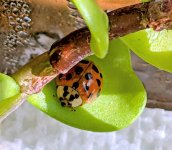
First post. Absolute novice on the topic, but I am so happy to have discovered this forum - albeit a bit late as the Asian lady beetle I was caring for is not doing so well (and may have already passed). But I want to understand more about the lifetimes, habitats, and heath issues of these little guys, and also want to know what I could have done differently. For those who have some time to come along the journey, please read more below.
Right before the first snow of the year, we noticed a single lady beetle who had made its way inside our home. This is not uncommon, as I understand they flock to warm indoor areas around Autumn, and then suffer from general lack of water resources and food in a dry indoor environment. Our family did not want to release this guy back into the winter weather, so we decided to build it a habitat and do our best in keeping it alive. I found a clear plastic fridge storage box with large holes, which I covered with foil and proceeded to poke smaller holes into the foil. It is also not exactly air-tight, as the lid sits loosely on top. I have some seedling heat mats at home that I use for my plants, and the box went on top of the heat mat quite nicely, by a window. I bought a small digital humidity/temperature sensor, which indicated the interior was at ~90% humidity and 71-72Fs, which sounded quite nice compared to the 10F temperature we were having outside. I had to do a lot of learning from the internet quite fast, and replaced pools of water with water-soaked paper towels in the habitat. The condensation inside also made for nice little dots of water on the ceiling. I made mixtures with sugar/nutritional yeast/water and placed small paper towel bundles soaked in these. We also added some cucumbers, occasionally honey/water soaked paper towel clumps, occasionally apple bits, nice little pebbles and rocks, and branches and sticks I gathered from my houseplants. I changed the habitat once every 1-2 days and aired it out each time, replenishing the food and tossing out anything that appeared to be rotting. I also changed the orientation of things every once in a while, to keep things interesting.
I am aware that aphids are the most common source of food for these guys, but as I also have plants at home, I did not want to purchase aphids and have them spread to all other nearby plants.
In the beginning, I would take great care in making sure the little guy did not fly away during changes, as it appeared eager to get out of there and fly off into the living room fast! I would watch it clean its wings and legs, especially after walking through any sticky/juicy parts in the habitat. In the mornings, I would occasionally find it motionless, and usually under a leaf or cucumber slice. Afterwards, it would "thaw out" and start moving around rigorously. I could not be sure if this was a form of "sleeping." The heat was on throughout the night in (or under) the habitat, although I do imagine the temperatures dipped to 69F at times - especially early mornings. (I had heard sometimes people ship ladybugs (to keep gardens healthy and to minimize aphids) as refrigerated items, and after coming to room temperature, they become animated again.)
This went on for quite some time, and we had no worries. It was walking, flying...etc. But one morning, I found it upside down in a corner of the habitat where a shallow layer of sugar/yeast paste had gathered. One of the flight wings was sticking out. The cause/consequence issue troubled me a bit, because 1) either something about the wings had gotten stuck because of the residual sugar/yeast paste (the single worst part of the habitat to get stuck in), or 2) the wing malfunction had occurred first, resulting in the beetle not being able to right itself and move out of the corner it had landed in. With the help of some very fine tweezers and toothpicks, I gently cleaned the guy with water. The more I observed the little beetle, the more it became obvious that the legs worked perfectly, and the elytra appeared to be stuck/shut. The one flight wing sticking out was creating a clear wobble when walking, and the elytra being stuck prevented the guy from being able to tuck back its flight wing, and limited its ability to right itself if it fell upside down or sideways. I did many rounds of gentle washes with water, utilizing a magnifying glass headset with light. To this day, I have no idea if what caused the wings to get stuck was residual sugar/yeast paste, or damage during flight (which may have taken place at any time during the day), or just ageing. A few times, it climbed up on my finger or a branch and tried to fly off of the top. You could clearly see it wiggling, struggling, and trying so hard to open its elytra, but it was not working, and I did not know how to make it happen manually without breaking or ripping them (if I tried to intervene with my tweezers). I only tugged at them very gently.
So I settled on perhaps having to take care of a flightless beetle from then on. I simplified the habitat and "lowered the ceiling" by putting a light layer of tissue on top of everything, so that if the little guy flipped, instead of righting itself using its elytra, it could just crawl on the new tissue ceiling instead. Perhaps with the elevated humidity in the habitat, enough water would get in and the shut wings would open on their own. Without the lowered ceiling, I kept finding it upside down each time I checked on it. We spent a few days in this format, and I was even excited to see that it would crawl outside of it and stay on top of the tissue layer by morning. This kept going until I found both flight wings sticking out, and shortly after, found it upside down again. After that, I am not seeing any signs of movement and recovery.
The first week after we started being hosts for our little guest, I also called out local conservatory to ask if they would allow us to set it free in their greenhouse. But I did not hear back, and we decided to continue taking care of the little guy.
If you have made it this far, thanks for sticking around to hear the tale of Mario the Asian Lady Beetle. "Mario" - because s/he has a red hat. I hope it enjoyed at least some of its time with us. I have a few lovely video captures from when it was at peak health.
Wishing everyone a wonderful holiday season.
- D.E.
First post. Absolute novice on the topic, but I am so happy to have discovered this forum - albeit a bit late as the Asian lady beetle I was caring for is not doing so well (and may have already passed). But I want to understand more about the lifetimes, habitats, and heath issues of these little guys, and also want to know what I could have done differently. For those who have some time to come along the journey, please read more below.
Right before the first snow of the year, we noticed a single lady beetle who had made its way inside our home. This is not uncommon, as I understand they flock to warm indoor areas around Autumn, and then suffer from general lack of water resources and food in a dry indoor environment. Our family did not want to release this guy back into the winter weather, so we decided to build it a habitat and do our best in keeping it alive. I found a clear plastic fridge storage box with large holes, which I covered with foil and proceeded to poke smaller holes into the foil. It is also not exactly air-tight, as the lid sits loosely on top. I have some seedling heat mats at home that I use for my plants, and the box went on top of the heat mat quite nicely, by a window. I bought a small digital humidity/temperature sensor, which indicated the interior was at ~90% humidity and 71-72Fs, which sounded quite nice compared to the 10F temperature we were having outside. I had to do a lot of learning from the internet quite fast, and replaced pools of water with water-soaked paper towels in the habitat. The condensation inside also made for nice little dots of water on the ceiling. I made mixtures with sugar/nutritional yeast/water and placed small paper towel bundles soaked in these. We also added some cucumbers, occasionally honey/water soaked paper towel clumps, occasionally apple bits, nice little pebbles and rocks, and branches and sticks I gathered from my houseplants. I changed the habitat once every 1-2 days and aired it out each time, replenishing the food and tossing out anything that appeared to be rotting. I also changed the orientation of things every once in a while, to keep things interesting.
I am aware that aphids are the most common source of food for these guys, but as I also have plants at home, I did not want to purchase aphids and have them spread to all other nearby plants.
In the beginning, I would take great care in making sure the little guy did not fly away during changes, as it appeared eager to get out of there and fly off into the living room fast! I would watch it clean its wings and legs, especially after walking through any sticky/juicy parts in the habitat. In the mornings, I would occasionally find it motionless, and usually under a leaf or cucumber slice. Afterwards, it would "thaw out" and start moving around rigorously. I could not be sure if this was a form of "sleeping." The heat was on throughout the night in (or under) the habitat, although I do imagine the temperatures dipped to 69F at times - especially early mornings. (I had heard sometimes people ship ladybugs (to keep gardens healthy and to minimize aphids) as refrigerated items, and after coming to room temperature, they become animated again.)
This went on for quite some time, and we had no worries. It was walking, flying...etc. But one morning, I found it upside down in a corner of the habitat where a shallow layer of sugar/yeast paste had gathered. One of the flight wings was sticking out. The cause/consequence issue troubled me a bit, because 1) either something about the wings had gotten stuck because of the residual sugar/yeast paste (the single worst part of the habitat to get stuck in), or 2) the wing malfunction had occurred first, resulting in the beetle not being able to right itself and move out of the corner it had landed in. With the help of some very fine tweezers and toothpicks, I gently cleaned the guy with water. The more I observed the little beetle, the more it became obvious that the legs worked perfectly, and the elytra appeared to be stuck/shut. The one flight wing sticking out was creating a clear wobble when walking, and the elytra being stuck prevented the guy from being able to tuck back its flight wing, and limited its ability to right itself if it fell upside down or sideways. I did many rounds of gentle washes with water, utilizing a magnifying glass headset with light. To this day, I have no idea if what caused the wings to get stuck was residual sugar/yeast paste, or damage during flight (which may have taken place at any time during the day), or just ageing. A few times, it climbed up on my finger or a branch and tried to fly off of the top. You could clearly see it wiggling, struggling, and trying so hard to open its elytra, but it was not working, and I did not know how to make it happen manually without breaking or ripping them (if I tried to intervene with my tweezers). I only tugged at them very gently.
So I settled on perhaps having to take care of a flightless beetle from then on. I simplified the habitat and "lowered the ceiling" by putting a light layer of tissue on top of everything, so that if the little guy flipped, instead of righting itself using its elytra, it could just crawl on the new tissue ceiling instead. Perhaps with the elevated humidity in the habitat, enough water would get in and the shut wings would open on their own. Without the lowered ceiling, I kept finding it upside down each time I checked on it. We spent a few days in this format, and I was even excited to see that it would crawl outside of it and stay on top of the tissue layer by morning. This kept going until I found both flight wings sticking out, and shortly after, found it upside down again. After that, I am not seeing any signs of movement and recovery.
The first week after we started being hosts for our little guest, I also called out local conservatory to ask if they would allow us to set it free in their greenhouse. But I did not hear back, and we decided to continue taking care of the little guy.
If you have made it this far, thanks for sticking around to hear the tale of Mario the Asian Lady Beetle. "Mario" - because s/he has a red hat. I hope it enjoyed at least some of its time with us. I have a few lovely video captures from when it was at peak health.
Wishing everyone a wonderful holiday season.
- D.E.