
Search results
-

New member
Welcome! It’s nice to see new members coming in after BeetleForum was almost shut down.- Eduardo
- Post #3
- Forum: Introduce Yourself
-
Is my Lucanus elaphus in prepupation?
Lucanus elaphus time periods can be pretty crazy. Sometimes they’ll complete their life cycle in under a year and others will wait an extra year in the infamous “prepupal” phase.- Eduardo
- Post #16
- Forum: General Beetle Discussions
-
anyone know of any invert/beetle expos in Ohio and Michigan? Do reptile expos cover inverts?
Wow! The native Dynastes?- Eduardo
- Post #7
- Forum: General Beetle Discussions
-
Cohabitated 10 gal tank
They are extremely hardy animals, don’t forget desert nights are cold. I provide mine with a moisture gradient, and they don’t necessarily have to be desert tenebs, any mix of teneb species are fun to watch. You have the amazing Alobates pennsylvanica in New England, and a nice colony of those...- Eduardo
- Post #4
- Forum: Enclosures and Housing
-
Cohabitated 10 gal tank
There’s nothing like a good desert beetles display. Even though they’re small they’re extremely entertaining to watch!- Eduardo
- Post #2
- Forum: Enclosures and Housing
-
Lucanus elaphus!
Yes, I’m currently keeping them at around 55 Fahrenheit. That is the only real downside to Lucanus, even the Asian species like formosanus and maculifemoratus from mountainous regions supposedly require cool temps.- Eduardo
- Post #8
- Forum: Beetle Photos
-
Are mites to be expected/common?
Mites are actually quite common in enclosures, including mine, but it’s the numbers that matter. Almost every bin will have mites, but they’re usually too few to be a problem.- Eduardo
- Post #7
- Forum: Health Issues
-
Telling Phanaeus Vindex and Phanaeus Difformis apart? (Females, and minor males)
Interesting question! I’m pretty sure P. vindex has a redder pronotum, even on tiny males, but the problem is color variation. It must be very hard without genitalia dissection. Here is a Vindex minor male showing the red pronotum. I don’t have any difformis at the moment to compare.- Eduardo
- Post #2
- Forum: General Beetle Discussions
-
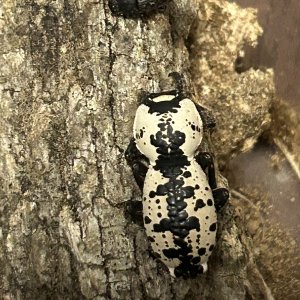
Zopherus nodulosus haldemani!
First one of the year, it’s been a while since I find one. I usually find no more than ten a year, and have not yet managed to breed them. Beautiful beetles though!- Eduardo
- Media item
- Comments: 0
- Category: Beetle Photos
-
Are mites to be expected/common?
As long as their numbers stay low you should be good. If their population isn’t kept at bay it may become a problem and the larvae become stunted. Good luck!- Eduardo
- Post #4
- Forum: Health Issues
-
Lucanus elaphus!
They simply didn’t lay eggs and the larval die-off was pretty substantial, other breeders have also reported this. I have a theory it might be lack of hibernation, so I’ll see what happens by hibernating my adults first.- Eduardo
- Post #6
- Forum: Beetle Photos
-
-
Are mites to be expected/common?
It all depends on the level of infestation and the species of mites. Grain mites are the most common and can deplete the nutrients in the substrate and cling to the larva’s spiracles. Around how many mites are there in one place that you can see?- Eduardo
- Post #2
- Forum: Health Issues
-
Dynastes grantii and D. tityus localities?
I know Orin McMonigle selectively bred D. tityus to increase and intensify their yellow coloration, I would imagine the same could be done with D. grantii and there is variability amongst individuals both in captivity and in the wild.- Eduardo
- Post #4
- Forum: General Beetle Discussions
-
Dynastes grantii and D. tityus localities?
That is interesting, but I don’t think there are any really defined localities. Tityus and Grantii are both part of the white Hercules lineage, which includes most North and Central American species minus D. tuxtluaensis. The Giant Hercules lineage occurs further south, and includes the D...- Eduardo
- Post #2
- Forum: General Beetle Discussions
-
Eleodes tricostata?
Thanks! This is my first time keeping these too, so I’ll let you know how it goes. Good luck! -
Eleodes tricostata?
Thanks! Was he successful with a specific method? The adults aren’t picky eaters. -
Eleodes tricostata?
Has anyone bred E. tricostata? Here in Texas there is a lot of Eleodes diversity, and I am specifically attempting to breed E. tricostata. I am keeping the adults in an enclosure with a 60% rotten wood and 40% compost/soil substrate with large pieces of rotten wood. Has anyone had success with... -
beetle capture help
Are you not looking to keep Oryctes? You’re lucky to have them native to your area and not invasive, and they seem to adapt very well to numerous conditions.- Eduardo
- Post #13
- Forum: General Beetle Discussions
-
beetle capture help
Also according to Inaturalist it also appears there are a few stags native to Singapore, an example being Prosopocoilus squamilateris. Why not try looking for those in rotten wood pieces? I have Prosopocoilus bison and they are fairly easy to keep in captivity. I don’t know about the Aegus...- Eduardo
- Post #10
- Forum: General Beetle Discussions